Simple FM Receiver with GNU Radio and RTL-SDR
Introduction
I recently started playing around with software defined radio using a USB TV tuner dongle utilising the popular RTL2832U chipset. After playing around with software like CubicSDR and gqrx I was somewhat frustrated at the opaqueness of what is going on under the hood. As such I resolved to learn GNU Radio so I can do the signal processing myself. Starting with a basic FM receiver seems like a good idea, since one of my goals is to receive NOAA APT transmissions, which are FM modulated at 137 MHz.
The image below is the FM radio (source code) I built in GNU Radio Companion. GNU Radio Companion is part of GNU Radio that makes it pretty easy to graphically put together a custom signal processing chain and "make" a radio in software. I am not usually a big fan of graphical programming, but in this particular instance I have to admit the going was a lot easier than if I had to do this textually. There is built in support for documenting each block, which is nice, though I wish I had more control over the font used and the size of the text boxes.
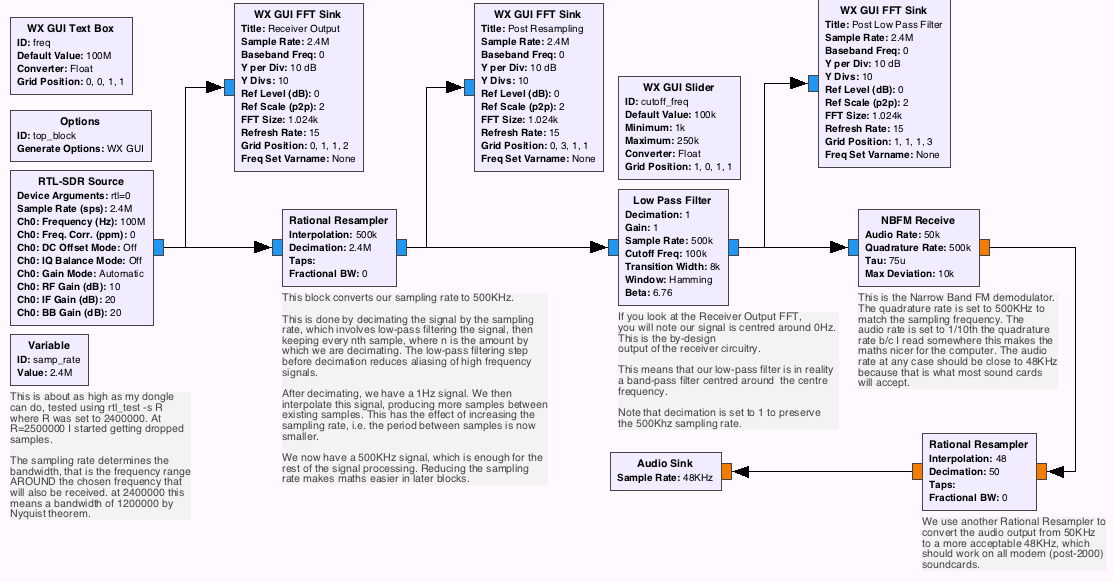 |
| FM radio created in GNU Radio Companion. |
|
| FM radio created in GNU Radio Companion. |
It looks more complicated than it is. Basically, the output from the receiver, which is centred around the central frequency, is down-sampled from 2.4 MHz to 500 KHz, then low-pass filtered and then passed to a FM demodulator module. The output of the FM demodulator is then resampled to 48 KHz and piped to an audio sink, i.e. a sound card.
All the extra stuff is are GUI controls and visualisations to aid in understanding and debugging.
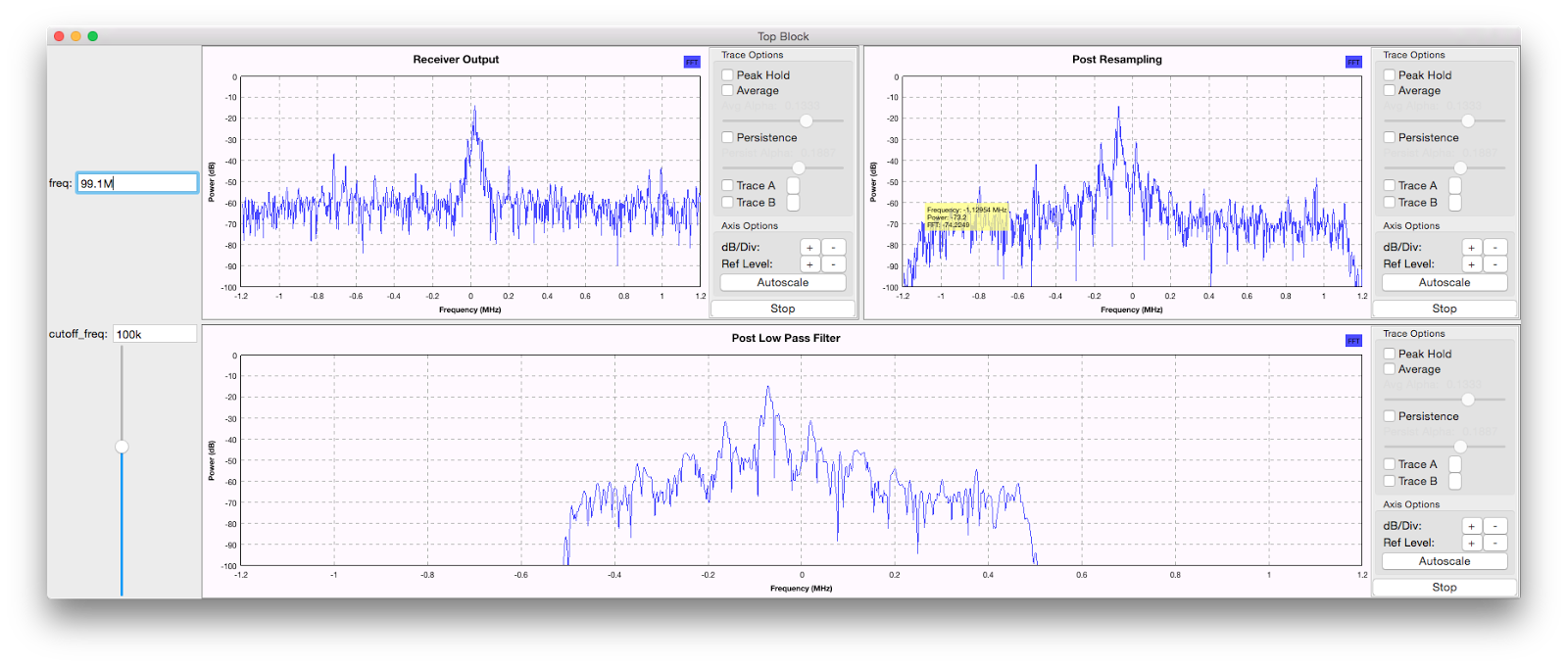
This is what it looks like running, tuned a local station at 99.1 MHz, which is BBC Radio 1.
| |
|:--:|
|  |
| Radio in operation. Top-left: FFT of the signal from the receiver; Top-right: resampled signal; Bottom: Low-pass filtered signal. |
|
| Radio in operation. Top-left: FFT of the signal from the receiver; Top-right: resampled signal; Bottom: Low-pass filtered signal. |
 |
| Radio in operation. Top-left: FFT of the signal from the receiver; Top-right: resampled signal; Bottom: Low-pass filtered signal. |
|
| Radio in operation. Top-left: FFT of the signal from the receiver; Top-right: resampled signal; Bottom: Low-pass filtered signal. |
There is some rudimentary control over GUI position and size, but it is otherwise brutally utilitarian. However the resulting python file can be modified to fine tune appearances and such I believe. Nonetheless, it is very useful for figuring out where you went wrong.
Next Step
The current goal is to make a NOAA APT specific radio and keep trying for a clean image.
Cheers,
Steve