Journey's End

Jan 23
2024

Estimating a Supernova's Brightness as an Amateur

Introduction

2023rve is the designation given to a Type II supernova discovered on 2023-09-08 by Mohammad Odeh from UAE. It appears to be part of NGC 1097, a galaxy 45 million light years away. Due to it’s brightness, 2023rve was visible to budget amateur astronomers/astrophotographers like myself.

Below is my first image of 2023rve.

2023rve

This is a stacked image consisting of 64x60s exposures captured using an unmodified Canon 800D attached to an Evostar 72ED. I was and continue to be very excited about this image because supernovas occur but rarely and are generally out of reach for budget setups like mine. Catching glimpse of one is not unlike seeing an unicorn.

Light Curves

2023rve is a type II supernova, and its light curve will look like one of the following depending on its subclassification (II-P, II-L, IIn or IIb).

Type II-P and type II-L supernova lightcurves

It occurred to me then that with sufficient images I can have a go at generating such a light curve and figure out what kind of supernova 2023rve is! This is a particular exciting idea to me because it takes supernovas from the realm of theory (knowing about them) into reality (studying them).

In the time since then, I managed 4 captures in total, including the one above, and this post documents my efforts in estimating the magnitude of 2023rve from my data and using that to construct a light curve.

General Approach

The idea is to calibrate my data, which are 60 second exposures of 2023rve, against stars of known visual magnitude. By comparing the pixel values that make up 2023rve vs these calibration stars, I can estimate its apparent visual magnitude. Then, making the assumption 2023rve is part of NGC1097, we can use the distance to NGC1097 to calculate the absolute magnitude of 2023rve and generate a light curve.

Identifying Stars

The first step is to find stars and their known magnitudes. While bright stars such as Rigel or Sirius have well known magnitudes, the stars in the vicinity of NGC1097 are less well known and unnamed. In order to look up stars in astronomical databases, we need their right-ascension (RA) and declination (DEC) coordinates. These coordinates serve the same purpose as GPS coordinates of latitude and longitude: they unique identify a position in the sky.

To locate our stars, I loaded my images into Siril and carried out platesolving, a method of locating images within the sky by looking at the pattern of the stars within the image.

Screenshot 2024-01-23 at 12.11.39 pm

Once platesolving is completed, I saved the file as a FITS file which embeds the coordinate information into the file metadata. I then open the FITS file in AstroImageJ and by manually adjusting the upper and lower limits on the histogram in the image viewer and zooming in, I am able to get a good view of NGC1097.

Screenshot 2024-01-23 at 12.50.16 pm

By right clicking on the image, a link to SIMBAD will open which allows all known stellar objects in the vicinity to be queried. Using this, three objects with known visual magnitudes were identified and annotated.

Screenshot 2024-01-23 at 12.49.26 pm

These are our reference stars and their visual magnitude is tabulated below.

Object Vmag
CD-30 1031 10.3
TYC 7011-484-1 11.39
TYC 7011-1028-1 12.15

Measuring Brightness

In order to relate the brightness of these stars to the measure pixel values, I used AstroImageJ’s single-aperture photometry tool, which samples a central circular region and an annulus around it. The central circular region should just fit the star while the annulus should contain only background. The background pixel value is estimated from the pixels within the annulus and subtracted from the stellar pixel values. This value is reported as Int Cnts. This measurement was done on each of the reference stars and 2023rve, e.g.

Screenshot 2024-01-22 at 12.32.31 pm

Deriving Visual Magnitude

Tabulating the Int Cnts obtained across the 4 observations produces the following:

CD-30 1031 TYC 7011-484-1 TYC 7011-1028-1 2023rve
2023-09-18 1.09E+06 4.54E+05 2.43E+05 2.77E+04
2023-09-24 1.09E+06 4.67E+05 2.60E+05 2.49E+04
2023-11-18 9.65E+05 4.32E+05 2.64E+05 1.20E+04
2024-01-22 1.14E+06 5.47E+05 2.73E+05 1.06E+03

It is quite pleasing that the Int Cnts values for the three reference stars are relatively stable, particularly as I am not using an uncooled sensor nor did I control for atmospheric conditions. Of the three reference stars, TYC 7011-1028-1 had the fewest saturating pixels and was the most stable over time, and was chosen as the reference against which to measure 2023rve’s brightness:

TYC 7011-1028-1 2023rve (2023rve) / (TYC 7011-1028-1)
2023-09-18 2.43E+05 2.77E+04 0.114
2023-09-24 2.60E+05 2.49E+04 0.096
2023-11-18 2.64E+05 1.20E+04 0.045
2024-01-22 2.73E+05 1.06E+03 0.004

By expressing 2023rve’s brightness in terms of TYC 7011-1028-1 I am implicit assuming the my sensor’s response is approximately linear for the brightness being measured.

Magnitudes are logarithms of ratios, so the brightness ratio in the table above turns into a difference in magnitude given by mag_diff=-2.5log10(x)) where x are the values in the final column. By adding this value from the visual magnitude of TYC 7011-1028-1 we arrive at an estimated visual magnitude for 2023rve:

(2023rve) / (TYC 7011-1028-1) mag_diff Vmag
2023-09-18 0.114 2.355 14.505
2023-09-24 0.096 2.545 14.695
2023-11-18 0.045 3.355 15.505
2024-01-22 0.004 6.030 18.180

Verification

The estimated visual magnitude of 2023rve looks quite reasonable, but is it correct? Thankfully professional astronomers have made their own measurements which I have collected below:

Date Vmag
2023-09-06 14.5
2023-09-11 13.9
2023-09-16 14.43
2023-09-24 14.390
2023-11-15 15.500
2024-01-06 16

Sources:

  1. https://www.wis-tns.org/astronotes/astronote/2023-247
  2. https://www.rochesterastronomy.org/supernova.html#2023rve
  3. https://www.flickr.com/photos/snimages/53209027493/in/photostream/
  4. http://gsaweb.ast.cam.ac.uk/alerts/alert/Gaia23cmp/

Compared against these, my visual magnitudes estimates compare quite favourably! I am pleasantly surprised how well things worked out. My last measurement, on 2024-01-22, stands out by how much it differs. It is also the measurement I have the least confidence in as by that point I could no longer reliably identify 2023rve in a single 60s exposure. I have some ideas here: take longer exposures or stack my exposures carefully (keeping values linear) and estimate from the stacked image.

Absolute Magnitude

The conversion to absolute magnitude is quite straight-forward as is the subsequent plotting.

Screenshot 2024-01-23 at 1.43.29 pm

Note that because I don’t know when peak brightness occurred, I am using days-since-discovery instead.

Type II Classification

I don’t think there is enough data yet to definitively say what subtype 2023rve is. More data points will decide the matter and I look forward to the next set of clear skies so I can continue this effort.

ts=12:11 tags=[astronomy]

Oct 27
2023

DIY EQMod Direct USB Cable

I am in the process of resurrecting my Eq5 Pro so it is compatible with ASIAir Mini. The first step is to build an EQMod Direct USB cable. While it is possible to buy one pre-made, since I had all the parts I decided to build it myself.

Based on …

Mar 05
2022

Adventures with Astroberry/KStars/Ekos

In astrophotography the combination of a goto mount, a camera and plate-solving is a powerful one. It allows you to do all kind of neat things, like polar-alignment without having a clear view of the south, extremely accurate goto functionality, and automated capture of multiple predefined targets.

There are roughly …

Feb 22
2022

Astrophotography Notes: ISO, Light Pollution, Histograms

ISO

I, like many people, thought that lower ISO means less noise. However this isn't true, at least not for modern camera. As a first order approximation, my understanding is that the signal path looks something like this:

  1. Photons impact the sensor
  2. Sensor generates electrical signal
  3. ISO amplifier amplifies the …
ts=14:32 tags=[astronomy]

Feb 09
2022

Verifying GoTo Mount Settings

I recently got a iOptron SmartEQ Pro+ mount and while setting it up I was confused over the time. Should it be local time and then I set the UTC offset in minutes? What do I do with the DST setting?

One way I found of checking whether my settings …

ts=06:16 tags=[astronomy]

Apr 22
2011

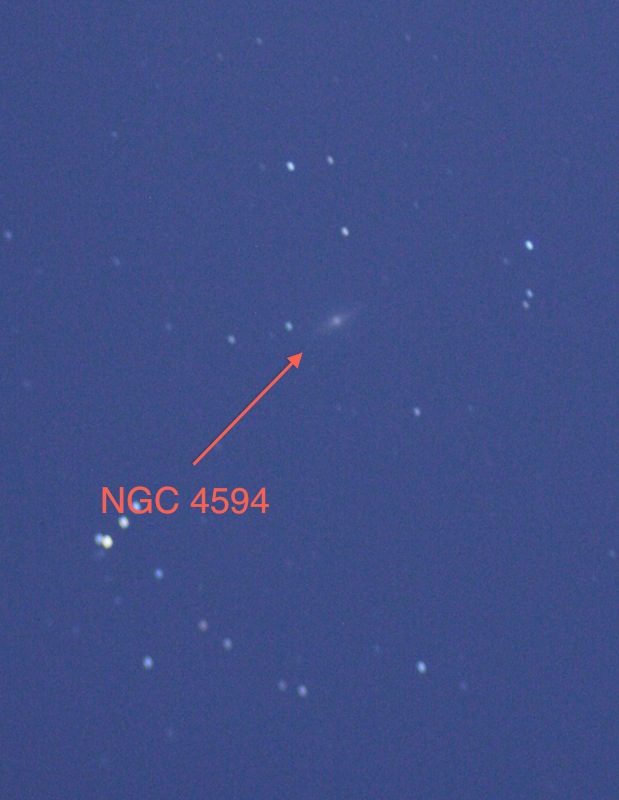
Another Galaxy Down

Found NGC 4594, aka the Sombrero Galaxy.

In addition also found what is probably cataracts in my eyes \>.\<


Cheers,

Steve

ts=14:16 tags=[astronomy]

Mar 26
2010

Notes on PHD Guiding

  • Maximum RA guide pulse is 1000ms (1s). If PHD is not locking on to the star and it says "dur=1000" in the status bar, a better polar alignment is required.
  • RA hysteresis is used in a 2-term weighted moving average:

RA_dist = (1.0 - RA_hysteresis) * RA_dist + RA_hysteresis * last_guide

Cheers,
Steve …

ts=02:45 tags=[astronomy,code]

Mar 11
2010

My First Galaxies (Kinda)

I finally managed to find some galaxies last night. This has been something that has eluded me due to my location, inexperience, and frankly inadequate equipment. (You in the back! Stop snickering!)

Last night, with my Canon 1000D I caught the barest glimpses of M83 and NGC 5128, aka the …

Sep 21
2009

Jun 20
2008

May 09
2007